Updated Website

The website has now been updated with new people and publications from 2021-2026.

2026

119. Harrison LM, Hughes J, Bretman A, Maklakov AA, Chapman T. (2026). Fast females, slow males: accelerated ageing and reproductive senescence in Drosophila melanogaster females across diverse social environments. Evolution Letters 10, 42-53

118. Pointer MD, Nash WJ, Gage MJG, Chapman T, Maklakov AA, and Richardson DS. (2026). Sexual selection purges mutation load, but not overall genetic diversity in populations, decreasing vulnerability to extinction. BioRxiv.

2025

117. Meyer DH, Maklakov AA, and Schumacher B. (2025). Aging by the clock and yet without a program. Nature Aging 5, 1946-1956

116. Ivimey-Cook ER, Sultanova Z, and Maklakov AA. (2025). Rapamycin, Not Metformin, Mirrors Dietary Restriction-Driven Lifespan Extension in Vertebrates: A Meta-Analysis. Aging Cell 24, e70131

115. Harris, I, Immler S, Chapman T, and Maklakov AA. (2025). Selection on the epigenome: small RNA inheritance in animal evolution. Trends in Genetics.

114. Sultanova Z, Shen A, Hencel K, Carlsson H, Crighton Z, Clifton D, Akay A, and Maklakov AA. (2025). Optimising Age-Specific Insulin Signalling to Slow Down Reproductive Ageing Increases Fitness in Different Nutritional Environments. Aging Cell 24, e14481

113. Cole, B., Vasudeva, R., Dragoi, K., Hibble, J., King, J., Maklakov, AA., and … (2025). Short experimental heatwaves have sublethal impacts on male reproduction in a model insect. Journal of Experimental Biology. 228 (15), jeb250555

112. Duxbury EML, Godden AM, Coriolis JC de, Carlsson H, Immler S, and Maklakov AA (2025). Lifespan-extending downregulation of insulin signalling reduces germline mutation load. BioRxiv.

111. Maklakov AA, Montano MA, Jones OR, and Nussey DH. (2025). Ecological Perspectives on Aging. Aging Cell 1, e70308

110. Moorad JA, Chapman T, and Maklakov AA. (2025). Mutation accumulation in genes with sex-biased fitness effects: A parsimonious explanation for sex differences in lifespan and ageing. EcoEvoRxiv.

109. Maklakov AA (2025). Evolution of Ageing and Lifespan. In Life History Evolution: Traits, Interactions, and Applications (pp. 29-48)

108. Harris I, Duxbury EML, Chapman T, Immler S, and Maklakov AA. (2025). Evolutionary trade-offs between intergenerational and transgenerational fitness effects. BioRxiv.

107. Irish SD, Kimberley A, Immler S, Moorad J, and Maklakov AA. (2025). Mutation accumulation underpins evolution of lifespan extension by dietary restriction. BioRxiv.

2024

106. Lemaitre JF, Moorad J, Gaillard JM, Maklakov AA, and Nussey DH. (2024). A unified framework for evolutionary genetic and physiological theories of aging. Plos Biology 22 , e3002513

105. Lind MI, Mautz BS, Carlsson H, Hinas A, Gudmunds E, and Maklakov AA. (2024). Sex-specific growth and lifespan effects of germline removal in the dioecious nematode Caenorhabditis remanei. Aging Cell 23, e14290

104. Duxbury, EML, Carlsson H, Kimberley A, Ridge Y, Johnson K, and Maklakov AA. (2024). Reduced insulin/IGF-1 signalling upregulates two anti-viral immune pathways, decreases viral load and increases survival under viral infection in C. elegans. GeroScience 46, 5767-5780

2023

103. Rostant WG, Mason JS, West N, Maklakov AA, and Chapman T. (2023). Sociosexual Exposure Has Opposing Effects on Male and Female Actuarial Senescence in the Fruit Fly Drosophila melanogaster. The Journals of Gerontology: Series A 78, 2230-2239

102. Chen H, Krieg, T, Mautz B, Jolly, C, Scofield D, Maklakov, AA, and Immler S. (2023). Germline mutation rate is elevated in young and old parents in Caenorhabditis remanei. Evolution Letters 7, 478-489

101. Ivimey-Cook ER, Murray DS, Coriolis JC de, Edden N, Immler S, and Maklakov AA. (2023). Fasting increases investment in soma upon refeeding at the cost of gamete quality in zebrafish. Proceedings of the Royal Society B 290, 20221556

2022

100. Aldholmi M, Ahmad R, Carretero‐Molina D, Pérez‐Victoria I, Martín J, Reyes F, Genilloud O, Gourbeyre L, Gefflaut T, Carlsson H and Maklakov AA, 2022. Euglenatides, potent antiproliferative cyclic peptides isolated from the freshwater photosynthetic microalga Euglena gracilisAngewandte Chemie International Edition 61, p.e202203175.

99. Duxbury EML, Carlsson H, Sales, K, Sultanova Z, Immler S, Chapman T, and Maklakov AA. (2022). Multigenerational downregulation of insulin/IGF-1 signaling in adulthood improves lineage survival, reproduction, and fitness in Caenorhabditis elegans supporting the developmental theory of ageing. Evolution 76, 2829-2845

2021

98. Carlsson H, Ivimey-Cook, E, Duxbury EML, Edden, N., Sales, K., and Maklakov AA. (2021). Ageing as Early Life Inertia: Disentangling life‚Äêhistory trade-offs along a lifetime of an individual. Evolution Letters 5, 551-564

97.Travers LM, Carlsson H, Lind MI, and Maklakov AA. (2021). Beneficial cumulative effects of old parental age on offspring fitness. Proceedings of the Royal Society B 288, 20211843

96. Sultanova Z, Ivimey-Cook ER, Chapman T, Maklakov AA (2021). Fitness benefits of dietary restriction. Proceedings of the Royal Society B 288, 20211787

95. Ivimey-Cook ER, Bricout, S, Candela, V, Maklakov, AA,, Berg, EC. (2021). Inbreeding reduces fitness of seed beetles under thermal stress. Journal of Evolutionary Biology 34, 1386-1396
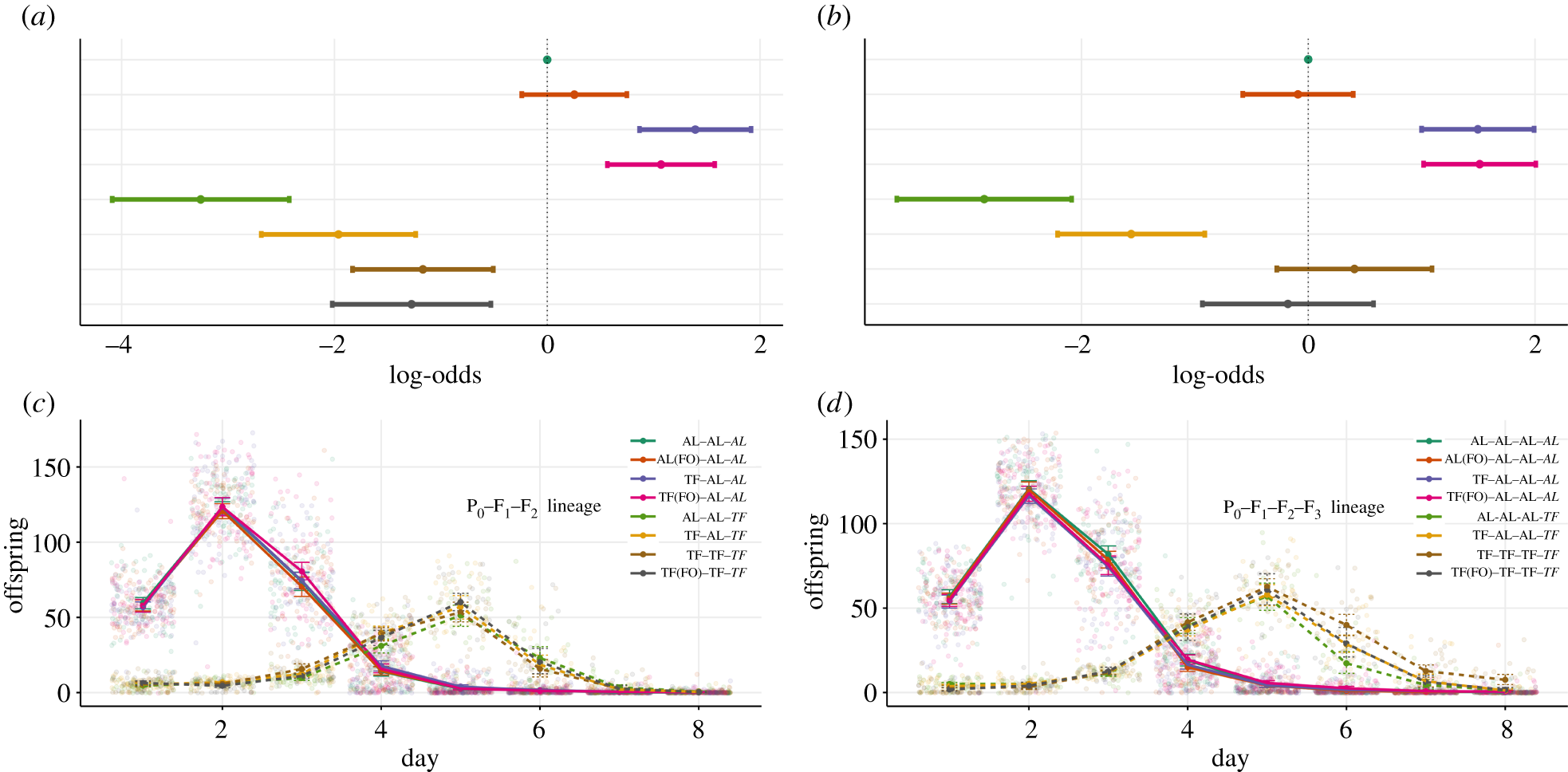
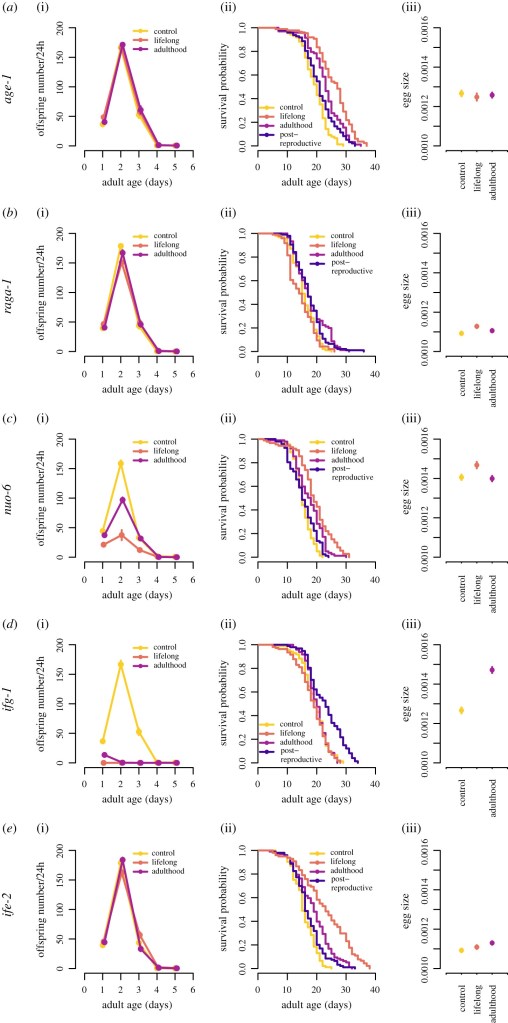
New paper led by @EdIvimeyCook: Transgenerational and intergenerational effects of dietary restriction via intermittent fasting in C. elegans – several super-interesting results!

Ivimey-Cook ER, Sales K, Carlsson H, Immler S, Chapman T, Maklakov AA (2021) Transgenerational fitness effects of lifespan extension by dietary restriction in Caenorhabditis elegans. Proc R Soc B, https://doi.org/10.1098/rspb.2021.0701

So, intergenerational effects (F1) improve fitness in the same intermittentfasting environment at the cost to fitness in the control environment – makes sense in every way and nice to see such clear result. Adaptive parental effects that come at a cost.

Transgenerational effects – they affect both lifespan and fitness up to F3! But – they reduce fitness of great-grandoffspring, not only that, they remove lifespan extension effect that is normally conferred byintermittentfasting!

In short, transgenerational (F3) effects of dietary restriction via intermittentfasting do occur but sometimes it would be better without them! Intergenerational effects are good when parents correctly guess offspring environment, otherwise not so much.

Transgenerational and intergenerational trade-offs is something to consider when studying their evolution.

New paper:

Lind MI, Carlsson H, Duxbury EML, Ivimey-Cook E, Maklakov AA (2021) Cost-free lifespan extension via optimisation of gene expression in adulthood aligns with the developmental theory of ageing. Proc R Soc B, 288: 20201728

ESEB 2019 in Turku

There were two ‘ageing’ symposia + a life-history symposium + a non-genetic effects symposium at ESEB 2019 – a lot of interesting and relevant talks.

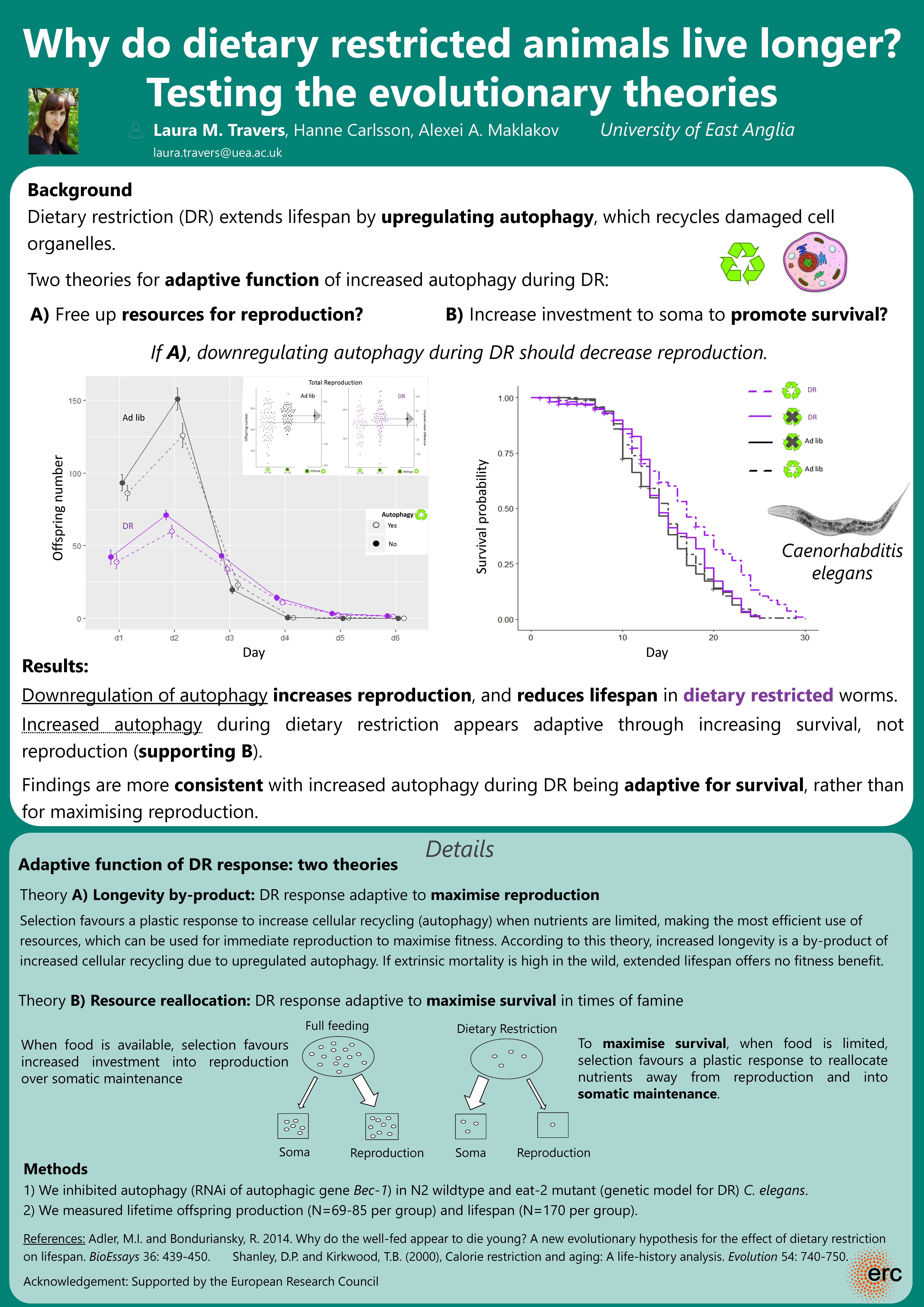
Laura Travers presented a poster on the effect of autophagy on survival and fitness under dietary restriction, testing recent evolutionary theory of DR.

Laura_ ESEB_poster

Here is the link to a session at Life-History symposium where I gave an invited talk on the role of non-energy-based trade-offs in ageing, highlighting the possibility that age-specificity of gene expression is not sufficiently optimised in adulthood and contributes to ageing. This presentation was followed by Irja Ratikainen’s invited talk who used C. remanei nematodes to test some of her models of the evolution of lifespan in variable environments in collaboration with Martin Lind’s lab in Uppsala and our lab. Finally, Ed Ivimey-Cook talked about our dietary restriction experiment in C. elegans that spans several generations later in the same session:

https://www.rajulive.fi/streams/session2-tuesday-morning

Next day, Liz Duxbury talked about the preliminary results of her mutation accumulation experiment testing how down-regulation of daf-2 expression in adulthood affects mutation rates:

https://www.rajulive.fi/streams/session6-wednesday-afternoon/

Preprint: Reduced insulin/IGF-1 signalling in adult parents increases offspring fitness

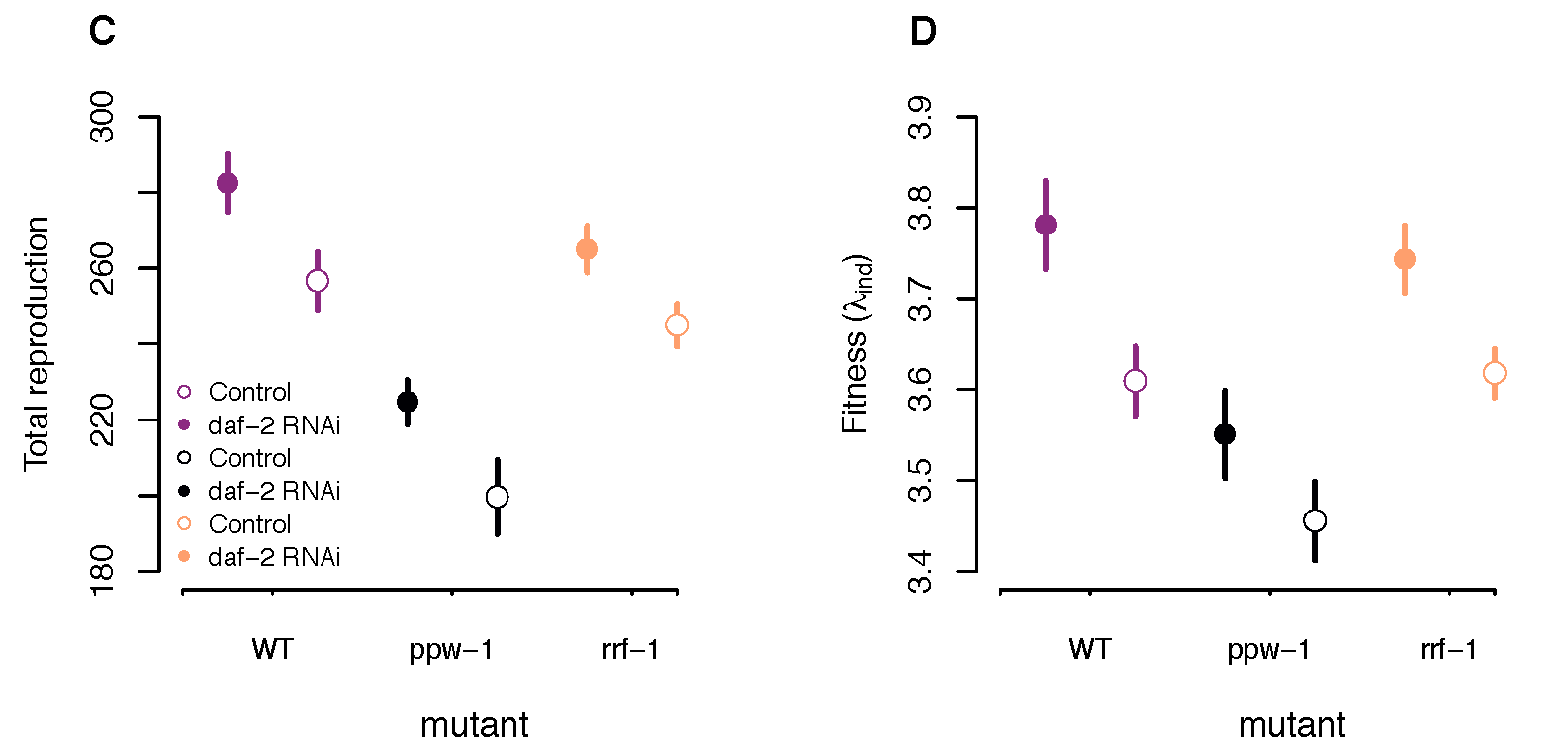
Reduced expression of the insulin/insulin-like nutrient-sensing signalling (IIS) pathway gene daf-2 in adult Caenorhabditis elegans nematode worms increases longevity without affecting fecundity, but the effect of parental lifespan extension on adult offspring is largely unknown. We found that reduced IIS signalling in parental generation increases offspring fitness. We used RNA interference (RNAi) to silence daf-2 expression in sexually mature C. elegans hermaphrodites from three different genotypes: N2 wildtype, as well as ppw-1 and rrf-1 mutants that are deficient for RNAi in germline and soma, respectively. Long-lived daf-2 RNAi parents showed normal fecundity as self-fertilizing hermaphrodites and improved late-life reproduction when mated to males. Remarkably, the offspring of daf-2 RNAi parents produced more progeny and had higher Darwinian fitness across all three genotypes. Thus, reduced IIS signalling in adulthood improves offspring quality supporting the emerging view that suboptimally high levels of nutrient-sensing signalling in late-life lie at the heart of ageing.

https://www.biorxiv.org/content/early/2018/08/31/405019


Fig4b


Ed Ivimey-Cook joins the lab

Ed joins our lab from October 1st as BBSRC-funded postdoc on the project that deals with transgenerational effects of dietary restriction on ageing and Darwinian fitness.

Ed has a general interest in ageing, maternal effects, and quantitative genetics. In particular, he is interested in understanding how biological processes and life-history trade-offs contribute to the vast observed diversity in trait ageing trajectories. For his PhD, he used experimental and widescale comparative analyses to investigate the detrimental effects of increasing maternal age manifested on offspring traits.

David Murray joins the lab

David Murray joins our lab as ERC-funded Research Technician on a collaborative project with Simone Immler’s group to work on ageing and reproduction in zebrafish.

David has a long-standing interest in aquatic ecosystems and, after finishing his PhD in Glasgow,  worked in Vienna and Berlin, and, most recently, at UEA in Matt Gage’s lab. He has broad interests in sustainable aquaculture, conservation biology and phenotypic plasticity.

KAaBUhNx_400x400

Elizabeth Duxbury joins the lab

Elizabeth joined our lab in July 2018 as ERC-funded postdoc. She is working on the relationship between ageing and germline mutation rate.

Previously, Elizabeth worked on sex-specific life history effects of dietary manipulation, and the evolution and genetics of virus resistance in natural populations of fruit fly species.

Photo for website

Laura Travers joins our lab

Laura Travers joined our lab as 3-year ERC-funded senior postdoctoral research associate to work on transgenerational effects of parental lifespan extension.

Laura has a broad interest in ageing, sexual selection, and evolutionary genetics. In particular, she is interested in understanding how trade-offs between life history traits such as reproduction and lifespan drive evolutionary change.

pic_Laura

The cost of longevity: BBSRC funding came through!!

Happy to announce that our BBSRC proposal with Co-Is Tracey Chapman (UEA BIO), Simone Immler (UEA BIO) and David Thybert (EI and UEA BIO) was approved and this means more research on the trans-generational consequences of parental lifespan extension!

We will be advertising positions for a postdoc and a research assistant (technician) soon!

Related image